
Factsheet: Cost of Disability - The lived reality
Issued on January 20 2026
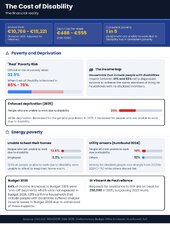
As part of our Emergency Winter Payment campaign alongside the Irish Wheelchair Association and Access for All, this factsheet outlines the severe financial reality faced by people with disabilities, estimating the annual Cost of Disability to be between €10,766 and €15,221. It highlights a significant income gap, noting that households with disabled members require 41% to 93% extra disposable income to match the standard of living of the general population , which pushes the "real" risk of poverty up to 76% when these extra costs are accounted for.
The document also details rising rates of enforced deprivation and utility arrears among those unable to work due to disability , while presenting "lived reality" quotes that describe the daily struggle of choosing between food and bills.
The Cost of Disability
Annual cost: The estimated annual cost of disability is between €10,766 and €15,221 (Indecon 2021 figures, adjusted for inflation).
Weekly cost: This translates to an extra cost per week of €488 to €555 (ESRI 2025).
Poverty and deprivation
"Real" poverty risk: While the official "at risk of poverty" rate is 32.5%, the rate rises to 65%–76% when the cost of disability is actually factored in.
Consistent poverty: 1 in 5 people who are unable to work due to disability live in consistent poverty.
The income gap: To achieve the same standard of living as households with no disabled members, households that include people with disabilities require between 41% and 93% extra disposable income.
Deprivation and arrears
Enforced deprivation: 39% of people who are unable to work due to disability face enforced deprivation.
Trends: While deprivation rates decreased for the general population in 2025, they increased for people who are unable to work due to disability.
Utility arrears: 19% of people unable to work due to disability are in utility arrears, compared to 12% of others.
Arrears increase: Arrears for disabled people rose sharply (+7%) from 2023 to 2024, while rates for others stayed flat.
Energy poverty
Heating: 13.6% of people unable to work due to disability were unable to afford to keep their home warm.
Comparison: This compares to only 3.2% of those who are employed.
Support and Budget context
Budget 2026 analysis: 64% of income increases in Budget 2025 were "one-off" payments that were not replaced in Budget 2026.
Impact: The ESRI confirms that households including people with disabilities suffered sharper income losses in Budget 2026 due to the withdrawal of these supports.
St. Vincent de Paul (SVP): Requests for assistance to SVP are on track to reach 250,000 in 2025, surpassing levels seen in 2022.
Data sources: CSO SILC 2024/2025, ESRI 2025, Parliamentary Budget Office, Indecon, Eurofound, and SVP.
Lived Reality - Voices from the Community
This section highlights quotes from lived experience submissions to Oireachtas committees and advocacy groups.
Financial hardship and survival
"Some weeks its a toss between food or bills as there's nothing left. The disability allowance I receive falls so short in covering my financial needs. I feel penalised and knowing I will continue to deteriorate with no hope for a better future for myself and my children can be unbearable."
"I have to attend a food bank weekly... apart from it being demoralising, it's a necessity to survive. I know the cold, long winter nights are only around the corner, and it scares me."
"Simply, the word saving does not apply to me, as I simply have nothing left over."
"I'm not looking to be a millionaire. I'm looking for security, home, heat, food, family and not to fight for every basic thing."
Healthcare and accessibility
"Because I don't have a medical card, I'm only allowed six physiotherapy sessions a year."
"I can't afford medication the doctor says I need... I drag out blood tests as long as I can."
Systemic flaws and employment barriers
"It's financially irresponsible of me to go full-time at work... it's better for me to stay part-time than it is to go full-time, which makes no sense."
"If I got a job I would lose my PA hours... the system makes no sense."
"When I reach 66, I lose all my disability payments, but the extra costs don't go away."
Social impact and independence
"We are more reliant than ever on our families and our independence is being eroded. This is not because of our disability. This is because we need to address the cost of living."
"You get tired of being the one who says 'sorry, I can't go'... people think you don't care, but you just can't afford it."
"The ministers making decisions don't have a clue what it's like to have a disability."
"People with disabilities shouldn't have to fight for everything."