DFI and Local Government
DFI's Work at the Local Level
Since 2004, DFI has worked closely with local authorities, community and voluntary sectors, and other stakeholders to promote disability inclusion. Recognising the importance of local government reform to improve the lives of persons with disabilities, DFI delivered conferences, training sessions and workshops advocating for the rights of disabled people and promoting their participation in local government decision-making. We have had direct involvement in development programmes such as the Social Inclusion and Community Activation Programme, SICAP and Leader where we represented disabled people in depriovation in local andd rural communities. In 2014, DFI invited the then Minister for the Environment Phil Hogan, to open our national conference entitled Citizen Engagement, Local Government for Local People.
Encouraging Community Advocacy
Taking a leading role among disability organisations, DFI has championed participation in Public Participation Networks (PPNs) which create connection between local governement and community groups. We also actively encourage self-advocacy and representation, and worked with the HSE to establish the Cashel Gold Star model. This model acknowledges agencies, businesses, organisations, community facilities and services that make adaptations and take measures to have their buildings, amenities and services made more welcoming and accessible to all people and supported and delivered training to access officers and other local actors.
Wicklow County Council and DISC
A standout example of DFI's work is its partnership with Wicklow County Council, where a DFI Community Development Officer has facilitated disability inclusion across stakeholders for over seven years. This collaboration led to the creation of DISC, a unique structure with Strategic Policy Committee status that oversees disability issues under the UNCRPD and the Wicklow County Disability Strategy.
While these efforts have driven significant progress, meaningful implementation of the UNCRPD requires holistic, well-resourced strategies, going beyond the role of Access Officers. Local Community Development Committees (LCDCs), which unite decision-makers and stakeholders to implement plans and strategies, offer the ideal framework for embedding UNCRPD principles into local government, ensuring tangible improvements in the lives of disabled people.
DFI has a longstanding and successful record of supporting the active engagement of members and individuals with lived experience in local decision-making. We are committed to working collaboratively with all stakeholders — locally, nationally, and at the EU level — to ensure that disability inclusion remains at the forefront of policy and practice.
However, effective implementation of the UN CRPD requires leadership and a collective commitment from all involved. No single group or stakeholder can achieve this alone. By working together, we can harness existing structures such as Local Community Development Committees (LCDC), Public Participation Networks (PPNs), and Strategic Policy Committees (SPCs) to advance real progress.
Bridging the Gap
While Ireland has made vital progress at a national level regarding the UN Convention on the Rights of Persons with Disabilities, UN CRPD, the reality on the ground often tells a different story. As one of Europe's most centralised nations, local authorities frequently lack the funding, coordination, and consistency needed to turn these national commitments into local realities. For disabled people, whose daily lives are shaped by local decisions on housing, transport, and public spaces, this disconnect translates into daily barriers and exclusion.
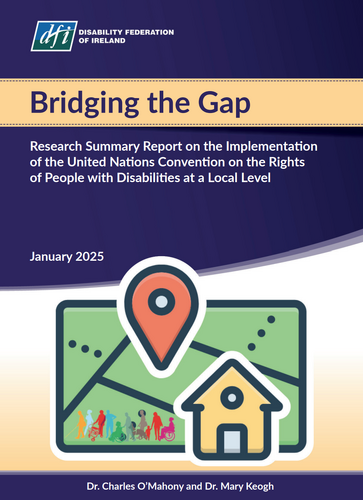
Our Bridging the Gap report is about connecting these national promises with meaningful, resourced local action. It calls for a shift away from treating disability inclusion as an under-funded "add-on" managed by part-time Access Officers, and towards embedding it as a core, cross-departmental priority. By establishing full-time, dedicated coordinators, standardising implementation across all 31 local authorities, and properly funding these mandates, we can utilise already proven local governance models to drive real change.
Crucially, this is a shared responsibility that must be co-designed alongside Disabled People’s Organisations, DPOs and disabled individuals themselves. By empowering local government with targeted training, clear metrics, and adequate national resources, we can translate the principles of the UN CRPD into tangible, everyday improvements—ultimately building equitable communities where everyone can thrive.