
"Compliance is the floor, not the ceiling": Sinéad Burke headlines DFI AGM 2026
June 26 2026, 04:06pm
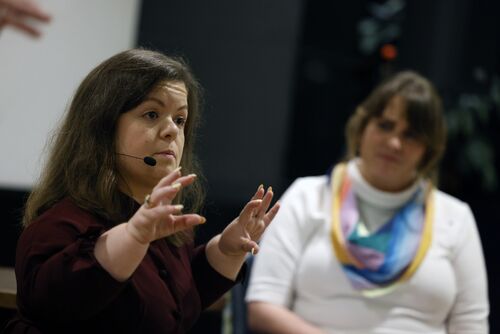
Tilting the Lens founder Sinéad Burke delivered a masterclass in disabled leadership at the DFI's Annual General Meeting on Wednesday 24 June 2026 at the Academy Plaza Hotel, Dublin. Members gathered to review the year's work and adopt the Annual Report 2025, before a wide-ranging afternoon conversation in which Burke urged the sector to move beyond compliance towards genuine, ambitious accessibility.
A masterclass in disabled leadership
DFI Director of Advocacy Emer Begley welcomed Sinéad, an educator, writer, broadcaster and global advocate whose consultancy works with brands including Gucci, Ralph Lauren, Netflix, Pinterest and Starbucks. Sinéad spoke about her personal connection to DFI's work, having grown up in a household of advocates. Her parents founded Little People of Ireland in 1997 and ran it voluntarily, giving her first-hand understanding of the sacrifices, good intentions and lack of resources that advocacy demands.
Asked what gives her hope, Sinéad pointed to progress, including government taking a human rights-based approach to strategy and policy, something she called a pipe dream a decade ago, while cautioning that the sector is still "filling the potholes of 20 years ago." Her central challenge to the room was that society continues to hold a low level of ambition for disabled people, and that the task ahead is not only to solve the past but to build the infrastructure for the future.
A recurring theme was the gap between compliance and genuine accessibility. She argued that compliance is the floor, not the ceiling, and that a compliance mindset too often places the burden on disabled people to identify problems without any commitment to fixing them. She drew on her consultancy's work across the built environment, workplace culture, and product and service design, emphasising her belief that lived experience is intellectual property.
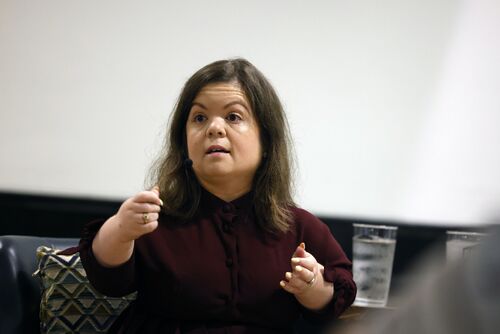
Through many examples, from an office building where evacuation lifts and a Changing Places bathroom were secured beyond the requirements of compliance, to the inaccessibility of new car designs and electric vehicle chargers, Sinéad made the case that accessibility requires disabled leadership in every room and every conversation. She described accessibility as being like a sandcastle: without constant building and attention, the tide simply washes it away. Culture, she argued, is not a set of principles but a set of consistent actions.
Responding to audience questions on remote work, tokenism, organisational culture and advocacy burnout, she spoke with striking honesty about the personal toll of public life and the importance of celebrating progress while continuing to push for change. She closed with an invitation to keep working together, sharing research and learning so the sector can move forward faster.
A year of advocacy, reviewed
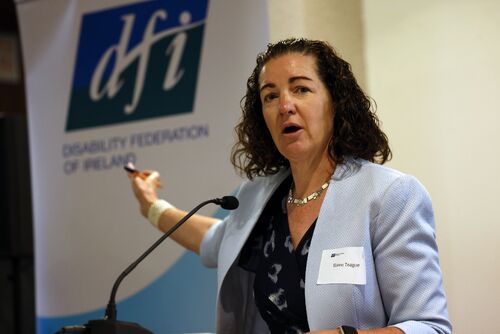
Earlier in the day, CEO Elaine Teague introduced DFI's Annual Report 2025, guiding members through the organisation's progress over the past year. She highlighted DFI's continued investment in member supports, the launch of a new eLearning programme on Disability Equality and Awareness, the Emergency Winter Payment Campaign, and the development of DFI's Pre-Budget Submission for Budget 2027, "The Least We Can Expect." Closing her address, she told members: "Together we can ensure that the rights of disabled people are not just recognised but realised."
Members share their stories
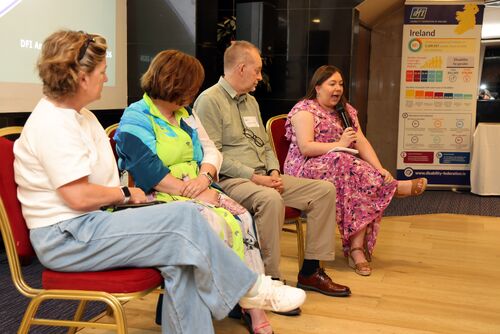
A highlight of the morning was a panel in which DFI members shared their experience of working with the Federation over the past year. The panel brought together four very different perspectives: Carol Brill, Founder and Chair of Usher Syndrome Ireland; Alison Ryan, CEO of Cork Centre for Independent Living; Richard Stables, Information and Support Manager at Headway Ireland; and Alison Cotter, Advocacy and Research Officer at MS Ireland.
Alison Cotter spoke about the power of collective action. She described how advocacy can feel like pushing a boulder uphill. Progress can be slow, and change can
be hard to achieve. Having a space like the DFI Policy and Advocacy Forum is crucial. It provides not just an opportunity to align on key priorities, but also a sense of shared
purpose and momentum.
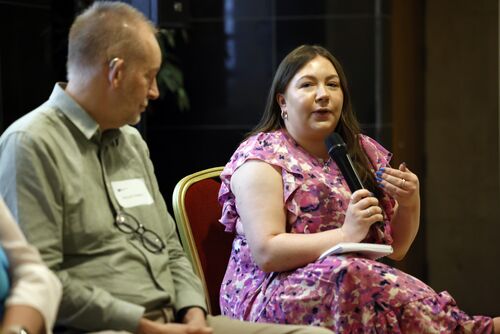
Carol Brill spoke movingly about the realities facing small, volunteer-led charities, including managing family breakdowns, mental health crises and complex rare-disease issues without professional resources or the manpower of larger organisations. She credited DFI with being a voice for her community when the capacity simply wasn't there, and praised the support DFI provides around governance, compliance and connecting small charities to others who have faced similar challenges.
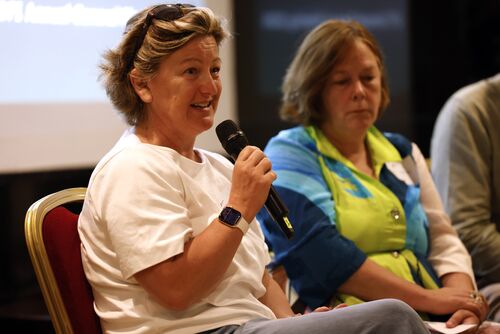
Alison Ryan described how DFI helped bring Ireland's 17 Centres for Independent Living together into the National Alliance for CILs. By securing and administering Training Links funding through The Wheel, DFI gave the centres a shared focus around sustainability, leadership and strategic planning and the structure needed to build trust and stay the course. She noted that collective working is not always easy, but that the resulting alliance now carries real weight on issues such as the future of Personal Assistance services, strengthened further by data from DFI's member survey.
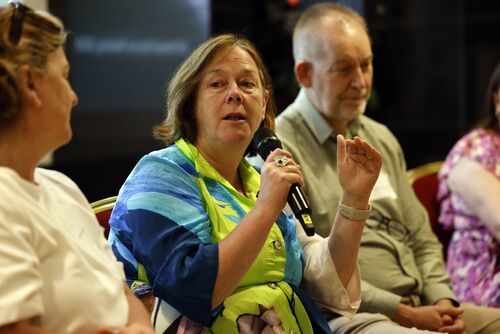
Richard Stables outlined his operational work with DFI on the implementation of New Directions standards for adult day services, working alongside the HSE and DFI's Cathy McGrath. He described the value of sitting in the room to test how policy will work in practice, keeping the process transparent and bringing members' real-world concerns to the table, a bi-directional flow of information that ensures members are briefed and the HSE is held to account.
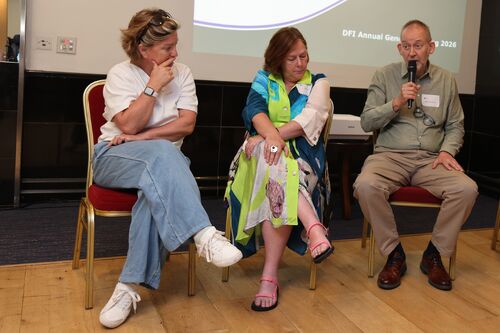
Drawing the threads together, DFI CEO Elaine Teague reflected on connection, credibility and mandate, shared advocacy, and practical supports. She remarked that what came through most strongly was the power of the collective and the value of being part of a national conversation broader than any single organisation, town or issue.
Looking ahead
Bringing the day to a close, DFI thanked SInéad Burke for a superb and generous contribution, looking ahead to future collaborations, and left members with a question to carry forward: how can each of us move one step from where we are, so that small steps together create real change in the right direction?
Thanks to all members who attended, to the panellists who shared their stories, and to Sinéad Burke and Tilting the Lens.