
Reflections from New York: What COSP Reminded Me About Disability Rights
June 16 2026, 05:04pm
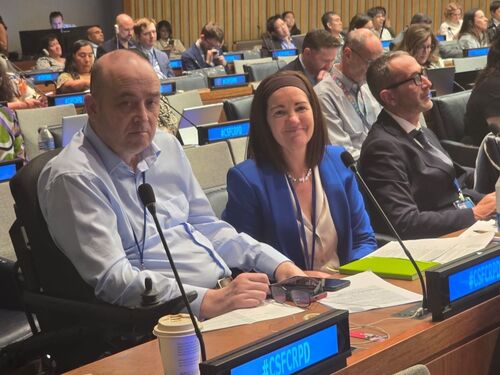
Last week, I had the honour of representing the Disability Federation of Ireland as part of the Irish Delegation to the United Nations Conference of States Parties to the CRPD (COSP) in New York. It was a privilege, and I want to share some reflections while they're still fresh.
Firstly, a sincere word of thanks to the Department of Foreign Affairs and the Department of Children, Disability and Equality. Both departments managed a complex, demanding event with real professionalism. Ireland showed up well.
Disability rights are human rights. We need to act like it
The overarching theme of this year's COSP was the UNCRPD at 20 years. The Convention on the Rights of Persons with Disabilities has been in force for two decades, and a consistent message throughout the conference was that disability rights are human rights. That framing matters. It shifts the conversation away from charity or welfare and towards obligations, accountability, and the full spectrum of rights that every person is entitled to.
Alongside that, there was a strong and repeated call for a mainstream response to disability rather than siloed disability services sitting outside the systems that everyone else uses. We need genuine inclusion within health, education, employment, housing, and every other domain of public life.
Ireland and the EU Council Presidency
Ireland is about to assume the Presidency of the European Council. I raised this at COSP as a significant opportunity. Rather than confining disability to a single disability-specific conference, the Presidency gives Ireland the chance to weave disability rights into the full programme of events.
This isn't just good practice. Ireland will be assessed against an EU Presidency Scorecard, and mainstreaming is one of the categories we'll be judged on. Let's use the opportunity well.
Recognising progress, while acknowledging how much remains to do
I reflected on how far Ireland has come on UNCRPD implementation, and there is genuine progress to acknowledge, including the Assisted Decision-Making (Capacity) Act, the National Human Rights Strategy for Disabled People, progress on safeguarding legislation, and Ireland's signing of the Optional Protocol. These are meaningful steps.
But there is a great deal more to do. Progress is not the same as arrival. The gap between what the Convention requires and what disabled people in Ireland actually experience in their daily lives remains significant.
Assistive Technology and AI: opportunity and risk
Assistive technology (AT) and artificial intelligence (AI) were major talking points throughout COSP. Ireland co-hosted a side event on AT, and the conversation was genuinely rich. It covered both the transformative potential of these technologies and the very real risks.
On the opportunity side, we heard inspiring examples including local libraries lending devices so people could try them before committing, device return and upgrade schemes, and training delivered in accessible, bite-sized formats. There is real innovation happening.
But the risks are just as real. The cost of devices can exclude the people who would benefit most. Privacy and data safety are serious concerns for people who may already be in vulnerable situations. And the threat of misinformation and disinformation affects everyone, but can hit people with disabilities particularly hard when they're relying on technology for information and communication.
This is an area DFI will continue to watch closely.
People with disabilities in areas of conflict
One of the most powerful and difficult sessions I attended focused on people with disabilities living in areas of conflict. Lived experience was shared from Sudan, Gaza, and Ukraine. It was honest, harrowing, and necessary to hear. Ireland facilitated that discussion and made sure people's voices were at the centre of it.
The realities of conflict came up repeatedly throughout COSP, but rarely with this level of directness. I was proud of how Ireland handled it, and when the Minister announced additional funding for the Global Disability Fund to support people with disabilities in conflict-affected areas.
A note on language
Language was something I noticed at COSP, and it may be useful to continue this conversation in an Irish context. There are some differences between how we frame language here and the approaches more commonly used across the EU and internationally.
For example, terms such as “people with disabilities” and “organisations of people with disabilities (OPDs)” are more widely used internationally, while in Ireland we often use “disabled people” and “DPOs.” At the same time, our use of “support” rather than “care” reflects a strong rights-based approach.
Language shapes how we think and engage. There is value in reflecting on these differences, and in continuing to accommodate and learn from both perspectives as this discussion evolves.
COSP was a reminder of how much this work matters and how much work remains. I came back energised, challenged, and more committed than ever to the mission of DFI and its member organisations.