
Disability Must Be Central to Ireland's Economic Conversation: DFI's input to the National Economic Dialogue | June 2026
June 15 2026, 04:44pm
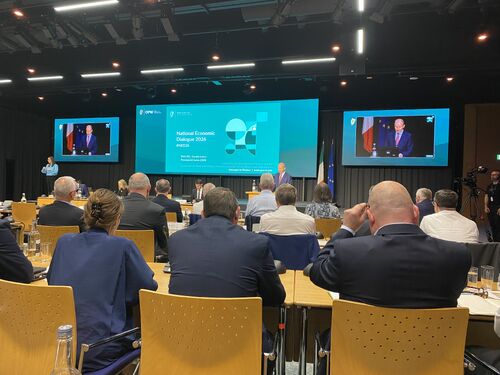
On Monday 15 June, we attended the National Economic Dialogue, where we had the opportunity to input directly to discussions on building a stronger, fairer and more resilient Ireland. DFI's Fleachta Phelan, Policy Advocacy Manager, and Emer Begley, Director of Advocacy, contributed at the plenary session. Below is the contribution we made on the day.
I am speaking on behalf of the Disability Federation of Ireland. We are a civil society, pan-disability organisations, with over 100 member organisations.
To note the importance of this year, as the 20th anniversary of United Nations Convention on the rights of disabled people. To acknowledge also the governments commitment to disability and the aims of the national human rights strategy for disabled people which are to move us to a place of greater equality and inclusion.
The discussion today is hugely relevant for us, as disability is mainstream disabled people face structural barriers to housing and health care, meet long waiting lists and lack of services, energy price rises, inflation and rising cost of living, inadequate income, and greater risks caused by climate change. .
There has been discussions on financial sustainability and a stronger, fairer and resilient Ireland today; at a fundamental level people require an adequate income.
Almost half (46.2%) of people unable to work due to disability are in the lowest 20% of the disposable equivalised income distribution, compared with one in ten employed people.
2 in 5 people unable to work due to disability live in enforced deprivation.
It is difficult to accept this level of poverty on an ongoing basis.
What we need in Budget 2027
People were significantly impacted in Budget 2026 with the withdrawal of the cost of disability grant and other supports. For some this was an income loss of upwards of €1,200 across the year.
We welcome the ongoing consultation on cost of disability but we need to see action on this in Budget 2027.
There is also huge positive potential to reduce the very significant disability employment gap. To do this, structural barriers for disabled people to employment, including addressing Cost of Disability, increasing the existing low level of income disregards, and ending the conditionality of essential disability supports like medical card and free transport, need to be addressed.
Finally, this morning An Taoiseach highlighted the importance of disability services and supports. These are the essential infrastructure to support independent living in the community. Critical, and welcome funding was allocated in Budget 2026 for disability-specialist services; potentially benefiting 95,000 people. This and all future funding for services requires greater transparency in how it is determined and allocated with a focus of raising all boats across section 38 and section 39 funded organisations, as community and voluntary organisations provide 70% of disability-community specific supports.
Multi-annual funding will be a key driver for community services, supporting innovation, efficient planning and continuity of services in the community, as we move to an inclusive and equitable Ireland.